 André Adolphe-Eugène Disdéri, former merchant, actor, and daguerreotypist, patented his invention, the carte-de-visite (visiting card) photograph, in 1854. At nine-by-six centimeters, cartes were primarily portraits, about the size of a conventional calling card and soon just as popular. Disdéri established his photographic practice with the manufacture of these tiny photographs; he divided a single glass plate negative to make ten different exposures and then printed them simultaneously. By 1862 he had expanded his operation to include a second studio in Paris, devoted entirely to equestrian portraits. Studios in London followed, and Disdéri, ever the showman and enterprising businessman, developed numerous photographic gimmicks to keep business afloat. The carte-de-visite was popular until the late 1860s, when it was replaced by the larger cabinet card format. Disdéri photographed views of the siege of Paris in 1870 and 1871, but the changed political and social climate contributed to the demise of his studio business. Following several bankruptcies, he moved to Nice in 1877 and ran a series of photography studios there. He returned to Paris in the late 1880s and died in an institution.
 Friday, 30 September 2011
How they mass produced in our period
André Adolphe-Eugène Disdéri, former merchant, actor, and daguerreotypist, patented his invention, the carte-de-visite (visiting card) photograph, in 1854. At nine-by-six centimeters, cartes were primarily portraits, about the size of a conventional calling card and soon just as popular. Disdéri established his photographic practice with the manufacture of these tiny photographs; he divided a single glass plate negative to make ten different exposures and then printed them simultaneously. By 1862 he had expanded his operation to include a second studio in Paris, devoted entirely to equestrian portraits. Studios in London followed, and Disdéri, ever the showman and enterprising businessman, developed numerous photographic gimmicks to keep business afloat. The carte-de-visite was popular until the late 1860s, when it was replaced by the larger cabinet card format. Disdéri photographed views of the siege of Paris in 1870 and 1871, but the changed political and social climate contributed to the demise of his studio business. Following several bankruptcies, he moved to Nice in 1877 and ran a series of photography studios there. He returned to Paris in the late 1880s and died in an institution. 
how they reproduced photos for publishing in our period
The term Woodburytype refers to both a photomechanical process and the print produced by this process. The process produces continuous tone images in slight relief. A chromated gelatin film is exposed under a photographic negative, which hardens in proportion to the amount of light. Then it is developed in hot water to remove all the unexposed gelatin and dried. This relief is pressed into a sheet of lead in a press with 5000 psi. This is an intaglio plate. It is used as a mold and is filled with pigmented gelatin. The gelatin layer is then pressed onto a paper support.
 The Woodburytype was developed by Walter B. Woodbury in 1864, first used in a publication in 1866 and widely used for fine book illustration from about 1870 to 1900.[1] It was the only commercially successful method for producing illustration material capable of replicating the subtleties and details of a photograph. It is the only mechanical printing method ever invented which produces true middle values and does not make use of a screen or other image deconstruction method.
Nāser al-Dīn Shah - Shah of Persia - Carte de Visite Woodburytype-Print from Felix Nadar Paris
The Woodburytype was developed by Walter B. Woodbury in 1864, first used in a publication in 1866 and widely used for fine book illustration from about 1870 to 1900.[1] It was the only commercially successful method for producing illustration material capable of replicating the subtleties and details of a photograph. It is the only mechanical printing method ever invented which produces true middle values and does not make use of a screen or other image deconstruction method.Thursday, 29 September 2011
Visiting card photographs popular in our period - carte de visite CDV
 The carte de visite (abbreviated CdV or CDV, and also spelled carte-de-visite or erroneously referred to as carte de ville) was a type of small photograph which was patented in Paris, France by photographer André Adolphe Eugène Disdéri in 1854, although first used by Louis Dodero.[1][2] It was usually made of an albumen print, which was a thin paper photograph mounted on a thicker paper card. The size of a carte de visite is 2⅛ × 3½ inches mounted on a card sized 2½ × 4 inches. In 1854, The format an overnight success, and the new invention was so popular it was known as "cardomania"[4] and eventually spread throughout the world.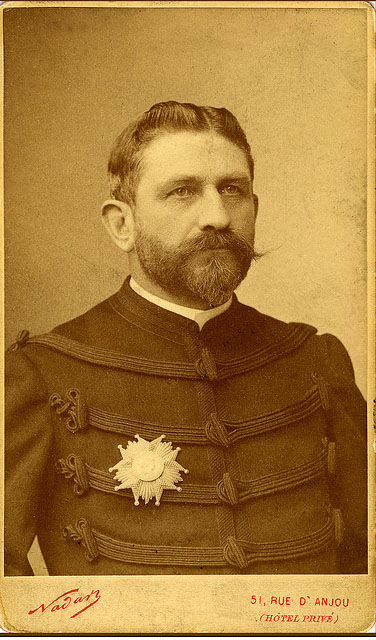

1860s recipe for the preparation of positive paper
Hi Ladies, maybe we could prepare some Albumen paper to hand out for our class engagement exercise? I've also bid on some 1860-1880's photos on ebay to hand around, I am hoping the price doesn't go to high, (as the shipping is dear enough from England).
Here is the way the albumen paper is prepared.
Allow the filtered albumen to settle for twelve hours; it is then ready for use. Draw sufficient quantity off into a shallow glass or Porcelain dish, without disturbing the sediment. It is a good precaution to strain it through a piece sponge placed in the neck of a glass or porcelain funnel. When circumstances permit, it is best to allow the albumen to repose four or five days before use. It appears to clarify itself, and gives a more brilliant surface to the positive paper.
2. Preparation of the Paper:--The positive paper must be carefully selected, and experimented upon. before the preparation of a large quantity is undertaken. If it be unequally sized, it will give uneven proofs and unsatisfactory results. Even the cutting of the paper to the required size demands much care, and only one sheet should be cut at a time, with an ivory paper-knife, without pressure or creasing.
Mark the back of the paper, and place it, sheet by sheet, carefully on the albumen without allowing the liquid to flow on to the back of the paper. This operation is best performed in damp weather, for then the albumen takes to the paper more readily, without forming bubbles, and the paper also dries more slowly and evenly. The first sheet floated is almost always defective.
Some little dexterity is required in floating the paper on the albumen ; the description of which is difficult, and necessarily unsatisfactory.
The time which the paper should be allowed to float upon the albumen will vary with the thickness and sizing of the paper: two minutes and a half may be taken as the average. It must not be reversed until it lies flat on the surface of the liquid. When this ensues, take the sheet by the two most distant corners, which, before it was floated on the albumen, have been previously folded back, and raise it slowly and regularly, so that the albumen forms a continuous, even coating over the whole surface. If the paper be raised too quickly, the albumen will flow down the paper in streaks, and the surface will dry uneven. By taking the paper at the corners most distant from each other, and suspending it to drain and dry in that position, the risk of drying unevenly is avoided.
3. Hanging and Drying the Paper.--The manner of hanging and drying the paper is one of the most important points, to avoid unevenness. The following method has always been successful, without causing any embarrassment to the operator:--Take two pieces of stout whipcord, and wax them, to prevent any fragments falling on to the wet paper; and string on each pieces of thin cork, of about an inch or an inch-and-half square, with holes pierced in the centre, through which the cord can freely pass. The cords are fastened to two walls, parallel to each other, with three bars of wood placed at equal distances along the cords to keep them apart; the distance must be a little greater than the width of the albumenised paper. Through each piece of cork a black-varnished pin must be passed upwards in a slanting direction, which penetrates the corners of the paper without difficulty. Care must be taken that the paper hangs fully distended and even, for, if it becomes curved, the albumen will dry upon its surface unequally. and spoil the proofs taken upon it. According to the extent of the operations, so may these suspending appliances be inch plied; they have the advantage of taking tip but little room, and are easily removed when the operation is over. The albumen that drains from the paper en be collected in dishes or on sheets of waste paper spread on the floor.
SIR,--In mechanically preparing albumen for photography the thorough and complete disintegration of every particle is indispensable.
By the ordinary fork process this is generally a long and tiresome job. I long contemplated making a machine to assist in the work, and have recently constructed a rough one, which answers completely, taking six minutes only to beat the albumen up instead of twenty-five, and producing a much better article, so much so that I think it would be impossible to make it as well by the fork.
 The apparatus is simple: a suitably shaped beater is rotated amongst the albumen in a basin (slowly at first, the speed being increased as the froth rises), by means of a pair of pulleys, in the proportion of about six to one, connected by a crossed band; a speed of upwards of five hundred revolutions per minute being easily attained. The standard, carrying the pulleys and beater shaft, slants at an angle of about forty-five degrees, and may be fastened to a table or board by a clamp.
When in use the large pulley is turned by the right hand, the basin containing the albumen, &c., being held in the left, so that the beater can have the proper dip, and every bit of the froth subjected to it effectually.
The enclosed print will show you the arrangement.
Here is the way the albumen paper is prepared.
THE PHOTOGRAPHIC NEWS, June 29, 1860, p.101
ON THE PREPARATION OF POSITIVE PAPER.
BY M. ALEO.1. Preparation of the Albumen:--Break the eggs into a graduated measure, carefully avoiding the mixture of yolk with the whites, and when the desired quantity of albumen is obtained separate the germs and pour the whites into a glazed earthen vessel, and to every 100 parts add 5 parts of a soluble chloride (that of ammonium is best), first dissolving it in as little water as possible. The quantity of water must not exceed one-tenth of the albumen, if a very brilliant surface on the proofs is desired. Beat the whites into a froth, and, after allowing it to settle for five minutes, remove the froth with a fork into a hair sieve, or muslin strainer placed over a second vessel. This operation to be continued whole of the whites are beaten into a froth and strained.Allow the filtered albumen to settle for twelve hours; it is then ready for use. Draw sufficient quantity off into a shallow glass or Porcelain dish, without disturbing the sediment. It is a good precaution to strain it through a piece sponge placed in the neck of a glass or porcelain funnel. When circumstances permit, it is best to allow the albumen to repose four or five days before use. It appears to clarify itself, and gives a more brilliant surface to the positive paper.
2. Preparation of the Paper:--The positive paper must be carefully selected, and experimented upon. before the preparation of a large quantity is undertaken. If it be unequally sized, it will give uneven proofs and unsatisfactory results. Even the cutting of the paper to the required size demands much care, and only one sheet should be cut at a time, with an ivory paper-knife, without pressure or creasing.
Mark the back of the paper, and place it, sheet by sheet, carefully on the albumen without allowing the liquid to flow on to the back of the paper. This operation is best performed in damp weather, for then the albumen takes to the paper more readily, without forming bubbles, and the paper also dries more slowly and evenly. The first sheet floated is almost always defective.
Some little dexterity is required in floating the paper on the albumen ; the description of which is difficult, and necessarily unsatisfactory.
The time which the paper should be allowed to float upon the albumen will vary with the thickness and sizing of the paper: two minutes and a half may be taken as the average. It must not be reversed until it lies flat on the surface of the liquid. When this ensues, take the sheet by the two most distant corners, which, before it was floated on the albumen, have been previously folded back, and raise it slowly and regularly, so that the albumen forms a continuous, even coating over the whole surface. If the paper be raised too quickly, the albumen will flow down the paper in streaks, and the surface will dry uneven. By taking the paper at the corners most distant from each other, and suspending it to drain and dry in that position, the risk of drying unevenly is avoided.
3. Hanging and Drying the Paper.--The manner of hanging and drying the paper is one of the most important points, to avoid unevenness. The following method has always been successful, without causing any embarrassment to the operator:--Take two pieces of stout whipcord, and wax them, to prevent any fragments falling on to the wet paper; and string on each pieces of thin cork, of about an inch or an inch-and-half square, with holes pierced in the centre, through which the cord can freely pass. The cords are fastened to two walls, parallel to each other, with three bars of wood placed at equal distances along the cords to keep them apart; the distance must be a little greater than the width of the albumenised paper. Through each piece of cork a black-varnished pin must be passed upwards in a slanting direction, which penetrates the corners of the paper without difficulty. Care must be taken that the paper hangs fully distended and even, for, if it becomes curved, the albumen will dry upon its surface unequally. and spoil the proofs taken upon it. According to the extent of the operations, so may these suspending appliances be inch plied; they have the advantage of taking tip but little room, and are easily removed when the operation is over. The albumen that drains from the paper en be collected in dishes or on sheets of waste paper spread on the floor.
THE PHOTOGRAPHIC JOURNAL. April 1, 1859. p.8
APPARATUS FOR FROTHING ALBUMEN.
To the EDITOR.SIR,--In mechanically preparing albumen for photography the thorough and complete disintegration of every particle is indispensable.
By the ordinary fork process this is generally a long and tiresome job. I long contemplated making a machine to assist in the work, and have recently constructed a rough one, which answers completely, taking six minutes only to beat the albumen up instead of twenty-five, and producing a much better article, so much so that I think it would be impossible to make it as well by the fork.
When in use the large pulley is turned by the right hand, the basin containing the albumen, &c., being held in the left, so that the beater can have the proper dip, and every bit of the froth subjected to it effectually.
The enclosed print will show you the arrangement.
Wednesday, 28 September 2011
double exposure ghost photos for you Elizabeth
Hi Elizabeth, in lieu of what we were discussing for your photograph yesterday, here are some double exposure ghost photographs on ebay, like the idea you had for your photo..??

 http://www.ebay.com.au/itm/Old-Photo-Antique-Bike-Double-Exposure-Ghost-1920s-/120783495754?pt=Art_Photo_Images&hash=item1c1f41e24a
Also this book below would be great if you get it from the library
'Ghosts Caught on Film' presents an extraordinary collection of strange and unexplained photographs that offer the exciting possibility of ghosts and paranormal activity captured on film. It covers every aspect of the paranormal, from early photographs of psychics, mediums and ghostly happenings, to celebrated recent photos and the most interesting examples of the unexplained, as collected in the archive of the Society for Psychical Research. Each picture is accompanied by a description of its circumstances and the steps taken by researchers to establish that there is no 'normal' explanation for the phenomena. The incredible photographs will stimulate the interest of everyone who sees them. Whether you are a sceptic or a believer, you can't help but be drawn into the mystery

 http://www.ebay.com.au/itm/Old-Photo-Antique-Bike-Double-Exposure-Ghost-1920s-/120783495754?pt=Art_Photo_Images&hash=item1c1f41e24a
Also this book below would be great if you get it from the library
'Ghosts Caught on Film' presents an extraordinary collection of strange and unexplained photographs that offer the exciting possibility of ghosts and paranormal activity captured on film. It covers every aspect of the paranormal, from early photographs of psychics, mediums and ghostly happenings, to celebrated recent photos and the most interesting examples of the unexplained, as collected in the archive of the Society for Psychical Research. Each picture is accompanied by a description of its circumstances and the steps taken by researchers to establish that there is no 'normal' explanation for the phenomena. The incredible photographs will stimulate the interest of everyone who sees them. Whether you are a sceptic or a believer, you can't help but be drawn into the mystery

ebay props


Subscribe to:
Posts (Atom)